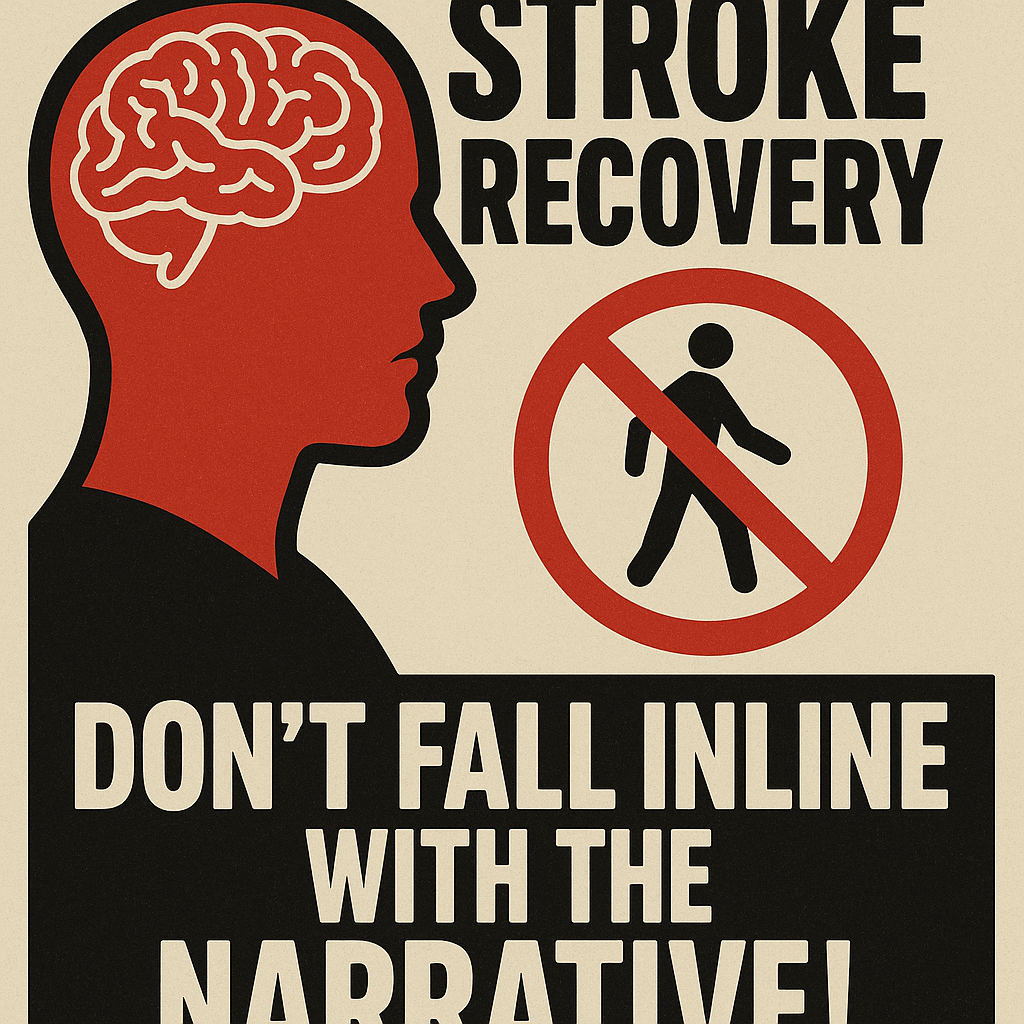
Stroke Recovery – Don’t Fall Inline With The Narrative!
As an Amazon Associate I earn from qualifying purchases.
What if “Plateau” Was Never a Natural Limit — But a Cage You Learned to Believe?
I can personally attest to this! If I listened I would have given up!
You push, you strain, you squeeze every drop of will and discipline out of your body. You’ve been to therapy, tried every exercise, endured frustration, tears, fear — and you keep hitting a wall. Your doctor shakes their head. The therapist glances down. You hear, “You’ve plateaued.” That word drops like a verdict.
But what if that plateau — the flat, immovable line you’ve been told is the boundary of your hope — isn’t a law of neurology or biology at all? What if it’s a psychological ceiling someone else taught you to obey?
What if everything you believed about your limits is complicit in your limits?
Because if the plateau is a lie — or a misinterpretation, or a misbelief — then the real tragedy isn’t your body stopping. It’s your mind giving up first.
The Biological “Plateau” — Real, But Limited
First: yes, the concept of a recovery plateau shows up in medical literature. Some studies refer to spontaneous recovery after stroke slowing or flattening out over time, often around 3–6 months (or earlier in more severe cases). Flint Rehab+2Tactus Therapy+2 Researchers caution, however, that what’s labeled “plateau” is heavily dependent on how recovery is measured, the intensity of therapy, and systemic constraints. PubMed+2BioMed Central+2
For example, a review by Demain et al. (2006) argues that the plateau is ambiguous — it isn’t simply a patient’s physical ceiling, but also shaped by how therapy is delivered, how measurement happens, and patients’ motivations. PubMed In other words, “no further gains” may reflect less therapy, less measurement sensitivity, or less intensity—not no potential.
Other recent works emphasize that neural reorganization and plasticity continue, though at slower rates, well beyond acute phases. BioMed Central+2Tactus Therapy+2
So yes — biology changes over time. Neural plasticity tends to be most robust early on. But slower doesn’t mean static; diminished doesn’t mean dead.
The Psychological Ceiling: What They Told You to Believe
Here’s where it gets dangerous: over time, patients internalize the idea of a plateau. It seeps in — via doctors, therapists, insurance limitations, rehab policies, and casual “that’s as good as it gets” remarks.
You start to treat the plateau like a wall you’re not allowed to break. You stop experimenting. You stop pushing boundaries. You stop believing that you can surprise yourself. That’s the psychological ceiling — internal disobedience to your own potential.
-
You obey it. It becomes safe. You cling to it. “Plateaued” feels final and definitive.
-
You stop asking better questions. Why didn’t therapy change this? Why not try something else?
-
You stop doing the “extra” things. Home exercises when nobody watches. Intensifying one movement for weeks. Small efforts that make no visible difference at first.
When the plateau becomes doctrine, your own curiosity stops. Your experiments cease. You begin to expect no change. And then — unsurprisingly — little change comes.
The Role of “Learned Non-Use” and Self-Fulfillment of Belief
An analogous idea already exists in stroke rehab: “learned non-use.” Constraint-Induced Movement Therapy (CIMT) was developed to combat this: after a stroke, patients often abandon use of the affected limb because initial attempts are inefficient, clumsy, or frustrating. Over time, the brain “learns” that trying is futile; the limb is effectively “shut down.” CIMT forces use, aiming to break this negative feedback loop. Wikipedia+1
The psychological plateau works similarly. You’re subtly discouraged from trying new movements, new intensities, novel stimuli. Belief shrinks. Fear grows. The mind greys out options before the body does.
A chilling possibility: what if more people stop recovering not because biology forbids it — but because they were conditioned to stop trying?
The Prison We Call “Therapy End”
Another structural lock: many insurance or institutional systems use a plateau as a cutoff. Once gains slow, therapy is reduced, tapered, or terminated. The unspoken assumption: diminishing returns means no returns.
That decision often arrives just when more creative, more patient, more daring therapy might break new ground. The system enforces the ceiling. It funnels you out.
The message: “We’ve done all we can.” But what if “all we can” was never enough in the first place?
Stories of Defiance: Patients Who Broke the Ceiling
The science community offers tantalizing hints. Case reports exist of stroke survivors making gains years, even decades later — long after any “plateau” was supposed to be final. Flint Rehab+2Recovery After Stroke+2 Some regain hand function, speech nuance, balance improvements — small but meaningful shifts.
Clinicians in practice sometimes tell whispered stories: “I saw her draw with that hand again, five years later.” Or, “He walked more steadily after we introduced a bizarre, unorthodox exercise.” These stories tend not to make headlines — they don’t fit the standard clinical narrative.
These are the cracks in the ceiling. And they prove the wall is not unbreakable.
Why Most People Never Try to Break It
Because breaking a psychological ceiling is painful:
-
Fear of disappointment. You’ve already tried so much. Trying more invites failure.
-
Cognitive fatigue. The mental cost is high. You have to believe differently to act differently.
-
Isolation. When others accept “plateau,” you become the odd one pushing harder.
-
Resource limits. Time, money, therapist bandwidth — pushing further often requires more leverage.
-
Lack of evidence in mainstream messaging. People say, “Prove it to me.” You try, struggle — the system ignores your small wins.
How to Smash the Ceiling (Reframe, Reclaim, Reignite)
Here’s how you begin to challenge it — not with wild optimism, but with purpose, strategy, and resolve.
1. Reframe plateau as pause, not prison
A plateau isn’t a sentence — it’s a signal that something needs to change: intensity, variation, novelty, feedback. When gains flatten, that often means habit and stagnation, not impossibility.
2. Track micro-progress, not grand leaps
Your traditional metrics (can you open that door, walk unaided, grasp that cup) might not detect the rearrangements happening behind the scenes. Instead, log subtle metrics: slight sensory shifts, reduced stiffness, finer control, new movement combinations. Momentum often hides in the seconds and millimeters.
3. Experiment methodically — treat yourself as a lab
What happens if you try a variation of an exercise? What if you increase reps by 10% for six weeks? What if you combine modalities — neuromodulation, mental imagery, haptic feedback, constraint-induced tasks? If you have a therapist or coach, propose mini “n = 1” experiments. Push just past the current edge.
4. Re-engage the belief system
Your inner narrative matters. Replace “this is all I’ll ever get” with “I don’t yet know all I’m capable of.” Surround yourself with stories of long-term recovery, with mentors, support groups, case studies. Shake loose ingrained assumptions that your condition defines your limit.
5. Leverage advanced techniques (when available)
Neuroscience is offering tools: neuromodulation, brain stimulation, targeted imaging to guide therapy, robotics, virtual reality, gamified reps. BioMed Central+2Flint Rehab+2 These tools don’t guarantee a miraculous breakthrough — but combined with a mindset of defiance, they shift the margin of possible.
6. Demand your right to experiment
Talk with your therapists, but also challenge them: ask why a certain strategy is being used or dropped. Ask what happens if you keep pushing. If “therapy time is up,” ask for a plan to continue yourself. If your system or insurance balks, explore alternatives: community programs, informal home-based systems, unorthodox methods.
Confronting the Inner Shock: The Mirror Question
Ask yourself:
-
If your body is telling you it can’t, but your mind is telling you it won’t — which one has been obeyed more often?
-
What part of you was first broken — your tissue, or your belief?
-
If halfway through this post you thought “this is too much,” what scared you? That you’ll fail? That you’ll have to try harder?
Those questions burn because they push you to see your own participation in your limits. That’s good. Revolutionary.
A Call to Misbelief: Dare to Disobey
I’m not promising miracles. I’m not asking you to reject medical science. I’m asking you to reclaim a portion of your recovery that may have been surrendered by default. I’m asking: what if the real barrier isn’t your damaged neurons, but the fear that nothing more is possible?
Every human system remembers more than it reveals. The brain hides reserves in redundancy, dormant circuits, latent pathways. Some of them can wake. But only if you refuse to accept the flat line.
So don’t just accept the “plateau.” Call it out. Experiment. Stretch. Agitate the system. Ask your brain, “Am I done? Or just deafened?”
Because sometimes, the biggest break in the system doesn’t come from more therapy — it comes from a thought that refuses to obey.
Amazon and the Amazon logo are trademarks of Amazon.com, Inc, or its affiliates.

